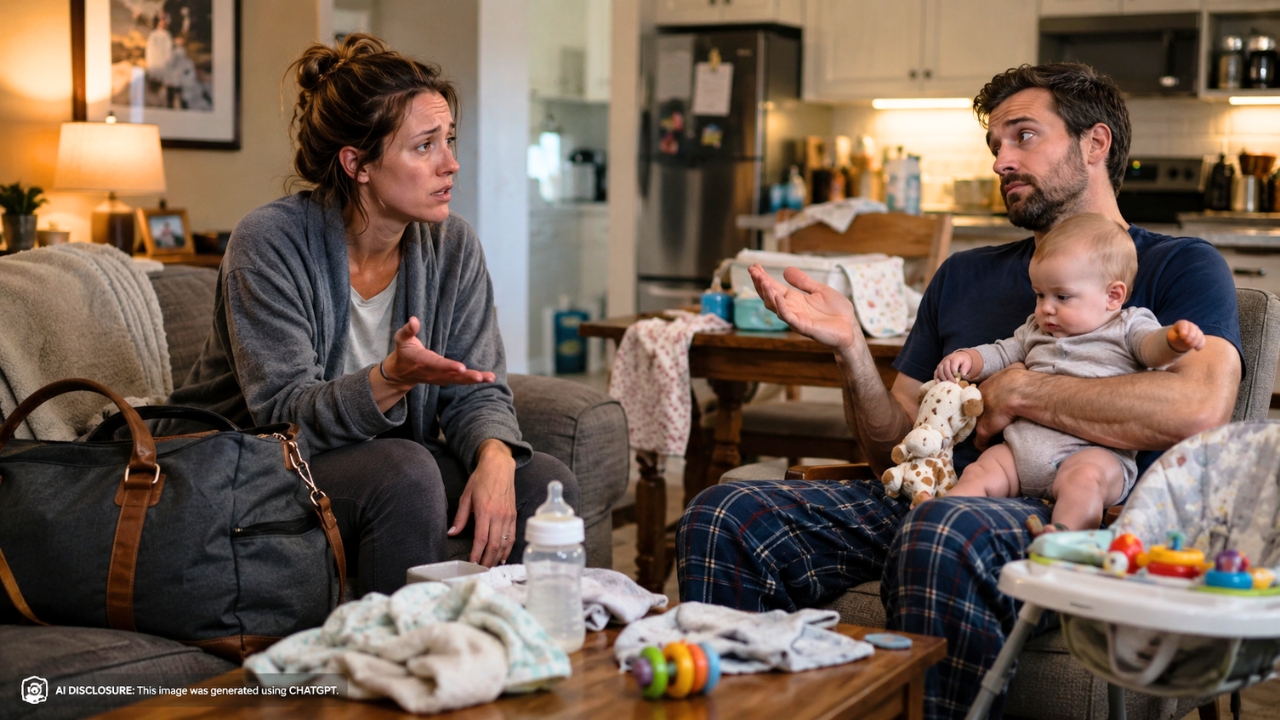
I Asked My Spouse for One Weekend Off From the Baby — I Was Told That’s Not How Parenting Works
Photo credit: AI-generated image created using ChatGPT. Illustrative only.
By the time the twins finally went down for the night, the house was quiet in the way only a day with babies can make it quiet—like the silence is earned. That was when a 37-year-old mom decided to ask for something that felt small on paper: a couple of days away to reset. The reaction she got from her wife wasn’t just a no. It was an explosion.
In her telling, the fight wasn’t really about one weekend. It was about months of exhaustion, a lopsided division of labor, and two people who are both running on empty—but only one of them feels allowed to say it out loud.
When the job loss turned into a new “normal”
The couple, a 37-year-old woman and her 42-year-old wife, are raising twin baby girls. Earlier on, they felt like a functioning team. A babysitter covered mornings, and when they were both home, they split chores and rotated the constant cycle of feeding, entertaining, and getting the babies settled.
Then about eight months ago, the younger spouse was laid off. They decided she would stay home “for a while,” taking care of the house and the babies while her wife continued working. Her wife, a software engineer, became the sole income while her partner tried to get back on her feet.
On the surface, it sounded like a reasonable adjustment. In practice, it slowly hardened into a one-person job.
Two babies, all day, plus the house—alone
She says she loves being with the twins and describes them as wonderful and well-behaved. But as they’ve grown more energetic, the days have gotten heavier. Handling two increasingly hyper babies while also keeping up with household chores started to feel less like parenting and more like an endless shift that never clocks out.
What changed wasn’t her wife’s love for the children, she says. It was her wife’s participation. Over time, she felt like she was doing “almost all of the parenting,” with her spouse increasingly checked out once she got home.
Her wife’s workdays are tiring, and she has taken on more workload to support the family alone. But when she comes home, the routine has become stark: dinner, then bed almost immediately. On weekends, her wife will spend time with the girls and get them to sleep, but she’s stopped doing her share of the chores and refuses to clean up after kid messes, according to the post.
The stay-at-home parent tried subtle hints that she was struggling. She didn’t feel heard—or worse, felt like the hints were being ignored because the arrangement was “working” for everyone but her.
The moment she asked to job-hunt again
A week before the blowup, she tried a different approach. She told her wife she planned to start job-hunting again. Instead of relief, she got resistance.
Her wife told her to wait a few more months and said the current setup was working great. The stay-at-home parent pushed back, arguing that they were both too overwhelmed and tired to spend quality time together anymore. Her wife waved it off as a temporary downward phase and insisted things would improve soon.
It’s a familiar pressure point for families: the fear that any change will break what’s holding things together. But for the person doing the day-to-day care, “holding things together” can feel like being stuck.
“Just one weekend” turned into a full-scale fight
The breaking point came after bedtime. She told her wife she was exhausted from carrying full responsibility for the house and kids and wanted to cool off for a couple of days by visiting a cousin in the suburbs that weekend.
Her wife “exploded,” she wrote. The working spouse accused her of being selfish for complaining, and said that if she couldn’t handle it, she shouldn’t have taken on the responsibility in the first place.
Then came the line that made the request feel like a personal attack: her wife said she works hard all week to make ends meet and doesn’t complain, so her partner was self-centered for “complaining all the time” about household chores and spending time with their kids.
The next morning, the argument didn’t resolve. Her wife left for work without saying a word. The silent exit landed as its own message: the working spouse still saw the request as an offense, not a warning light.
Where people said the real imbalance was hiding
In the original post, the stay-at-home mom framed the question as whether she was wrong to complain—and whether it was fair to ask for a weekend away. But much of the reaction focused on something more practical: the couple is treating childcare and housework like “not real work” unless it comes with a paycheck.
People also zeroed in on the way her wife described weekends. The stay-at-home parent pointed out that her spouse gets breaks from her stressful job on weekends, while she doesn’t get an equivalent reset. The implication wasn’t that the working parent has it easy; it was that one person’s fatigue is being treated as valid, and the other person’s fatigue is being treated as whining.
Others honed in on the long-term risk: if the working spouse truly believes the at-home parent forfeited the right to breaks by agreeing to stay home “for a while,” then the arrangement isn’t just unbalanced—it’s unstable. The twins will keep getting more active. The chores will keep coming. And resentment doesn’t stay quiet forever.
What happens if nobody taps out safely
The couple now has two pressures colliding at once: financial strain and caregiver burnout. The working spouse is carrying the income, likely feeling the weight of that responsibility, and responding by shutting down at home. The stay-at-home parent is carrying the daily physical and emotional load of two babies, responding by asking for time away—and being told that needing relief is a character flaw.
It’s also not a small operational question. If one parent leaves for a weekend, the other has to do everything: diapers, meals, naps, bedtime, cleanup, and the unpredictable moments in between. But that’s also the point the stay-at-home parent is making—she already does “everything” most days, and she’s asking her wife to experience that reality for a short stretch.
There’s no tidy ending in the post, just a household that woke up after a fight and kept moving because babies don’t pause. The stay-at-home mom says she feels guilty and understands her wife’s stress, but she’s also stung by the suggestion that her work is less important. For now, the weekend request has become a referendum on how they see each other’s labor—and whether either of them is allowed to admit they’re not okay.

Abbie Clark is the founder and editor of Now Rundown, covering the stories that hit households first—health, politics, insurance, home costs, scams, and the fine print people often learn too late.