My Sister-in-Law Threatened to Cause a Scene at Mother’s Day If I Showed Up — So I Showed Up
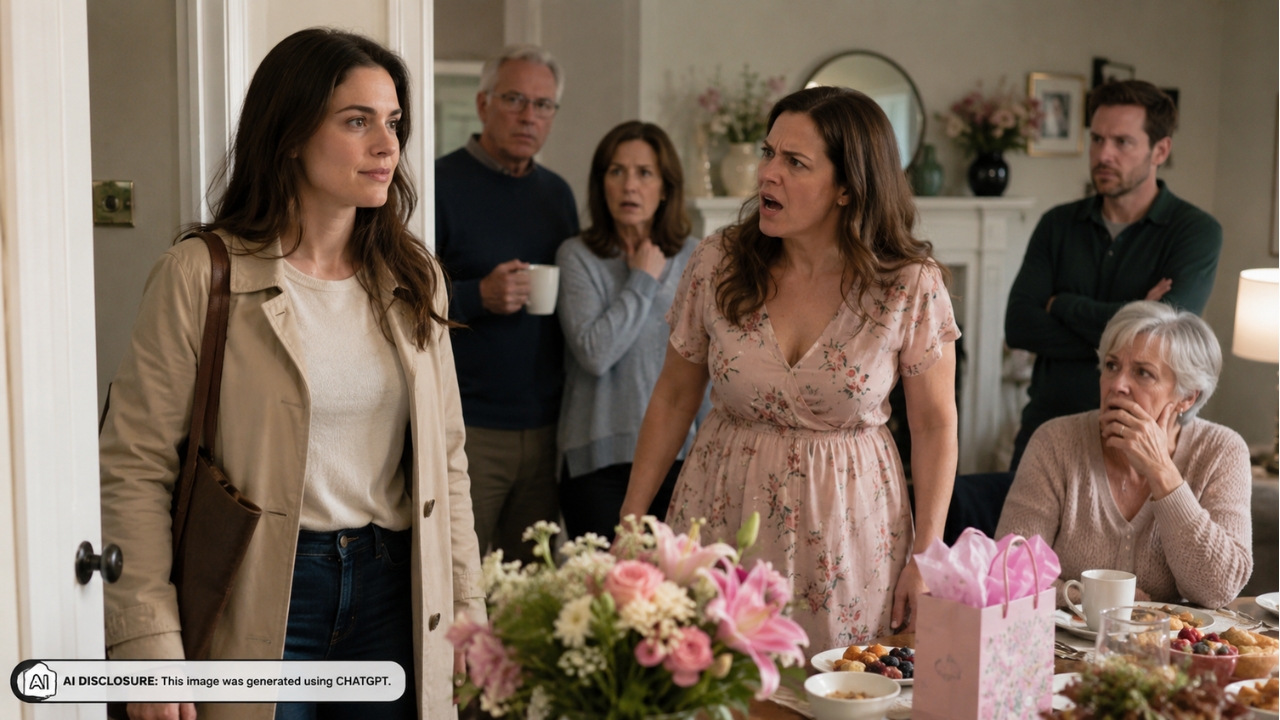
Photo credit: AI-generated image created using ChatGPT. Illustrative only.
It was supposed to be a simple plan: arrive with her husband, hand his mom a handmade gift, and keep the peace. Instead, one warning from a sister-in-law—“don’t come, or I’ll make a scene”—turned Mother’s Day into a test of who actually gets to decide who belongs in the family living room.
In a post shared online, a woman described being told in advance that her presence would “ruin everyone’s day.” She went anyway, believing her mother-in-law would want her there. The blowup came fast, in front of the person the day was meant to celebrate.
A warning that sounded like a trap
The writer said her sister-in-law, “Cleo,” tried to make the rules for Mother’s Day before anyone even walked through the door. Cleo insisted that “nobody” wanted the writer around, and proposed a workaround: drop off the writer’s husband, Ryan, and leave.
If she didn’t? Cleo allegedly promised to make her attendance “everyone’s problem.” It wasn’t framed as a request or a boundary—it was a threat of public embarrassment, aimed at discouraging her from showing up at all.
Ryan, however, didn’t agree to the drop-off plan. The writer said her husband wanted her there and believed his mother would want that too. To them, Cleo was trying to override the household’s actual host: Ryan’s mom.
The backstory: distrust, control, and an old argument
The tension between the two women wasn’t new, and the writer tied it to a larger issue Cleo has with their marriage. Ryan is disabled, and Cleo believes she needs to “protect him” from the writer—an attitude the writer described as dismissive of Ryan’s own ability to speak for himself.
The disagreement appears rooted in Cleo’s disapproval of the couple’s open marriage and what the writer described as Cleo not trusting Ryan’s “lived experience.” The writer said Cleo tried to confront her about it previously and “ended up looking foolish,” leaving what the writer suspects is lingering resentment and a bruised ego.
By Mother’s Day, it wasn’t just about marital choices. It was about control: who gets to define what’s appropriate, and who gets to decide what Ryan needs.
She showed up anyway—with a gift and a plan to leave if asked
Despite the warning, the writer went forward with what she saw as the respectful approach. She said she has a good relationship with her mother-in-law and had made her a stained glass piece featuring lilacs—her mother-in-law’s favorite flower.
Her plan was direct and, in her mind, fair: arrive with Ryan, find her mother-in-law, give her the gift, and confirm she actually wanted her there. If her mother-in-law didn’t, she would leave. “It’s her day, not Cleo’s,” she wrote.
When they arrived, the greeting seemed to validate that decision. The mother-in-law was happy to see both of them, hugged them, brought them inside, and loved the lilac stained glass enough to put it up immediately in her kitchen window.
For a moment, it looked like Cleo’s ultimatum would fizzle out. Then Cleo pulled the writer aside.
The confrontation happened in the open—and the host stepped in
Cleo cornered her and demanded to know why she came after being “clearly” told not to. She argued that the mother-in-law deserved time with her children “without interlopers,” as the writer paraphrased it, noting Cleo’s original wording was more colorful.
The digging didn’t stay private for long. The writer said Cleo kept at it until the mother-in-law noticed and asked what was going on. That forced Cleo to say the quiet part out loud: she had warned the writer not to come.
At that point, the mother-in-law tried to shut it down. She told Cleo to knock it off. When Cleo doubled down—insisting the writer was “the problem,” not her—the mother-in-law got firmer, telling her to stop and making it clear that whatever was happening between them was “just between” them.
Cleo didn’t accept that. According to the writer, she became angry, grabbed her purse, and left. Mother’s Day continued, but the mood changed. The writer described the family relaxing afterward, yet acknowledged the “vibe shifted,” and she felt responsible for the cloud hanging over the gathering.
The next day brought a new threat: “I will prove it”
At home, Ryan told her she hadn’t done anything wrong. In his view, Cleo was the one creating damage, alienating the family by acting like she knows what’s best for everyone—especially for him. He also said he would try talking to her again, though the last attempt went nowhere because Cleo wouldn’t listen.
Then Cleo escalated outside the party setting. The next day, she sent several long messages that the writer summarized as: “I do not trust you, and I will prove to everyone that you are no good, and you ruined Mother’s Day.”
That shift—from arguing about attendance to promising to “prove” someone is bad—raised the stakes. It suggests Cleo isn’t just venting; she’s building a narrative she plans to sell to the rest of the family, potentially turning future gatherings into repeated loyalty tests.
The writer’s lingering question was simple and uncomfortable: was she wrong to go, knowing Cleo had warned she would do something? Even if Cleo was the one who stormed out, Cleo is the mother-in-law’s daughter, and the writer is not.
What readers zeroed in on: boundaries, hosting rights, and receipts
In the original post, the detail that kept jumping out wasn’t the open marriage itself—it was Cleo’s attempt to gatekeep a holiday hosted by someone else. The mother-in-law’s reaction mattered: she welcomed the writer, displayed the gift, and told her own daughter to stop. To many readers, that made the host’s preference clear.
Another theme was Ryan’s autonomy. The writer framed Cleo’s behavior as paternalistic—treating a disabled adult as someone whose choices don’t count unless Cleo approves them. The fact that Ryan wanted his wife there, and that Cleo still tried to engineer a drop-off, came off as controlling rather than protective.
Practically, readers tend to encourage documentation when a family member starts sending “I’ll prove it” messages. Not because family disputes belong in court, but because accusations can travel fast and stick. Saving texts, keeping communication in writing, and having Ryan present for any future conversations can reduce the odds of misrepresentation later.
For now, the family appears stuck with an unresolved reality: the mother-in-law didn’t ask the writer to leave, but Cleo seems committed to treating her presence as an offense. The Mother’s Day blowup ended with one person walking out, one person feeling guilty, and a warning that next time might not stay contained to a single afternoon.

Abbie Clark is the founder and editor of Now Rundown, covering the stories that hit households first—health, politics, insurance, home costs, scams, and the fine print people often learn too late.