Husband’s Family Showed Up With a Moving Truck for the Spare Room
Photo credit: Nowrundown.com
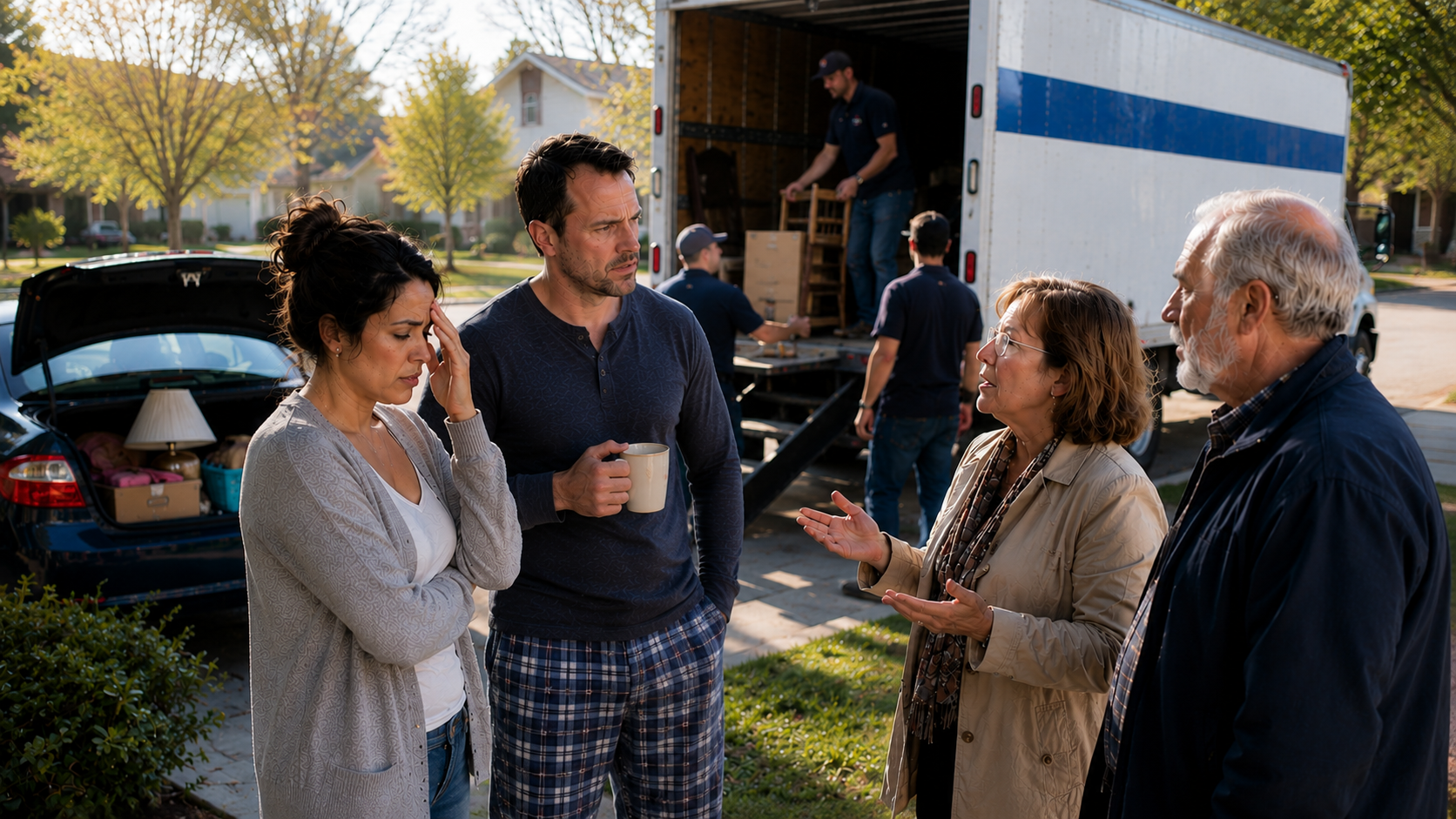
When the doorbell camera lit up on a quiet Saturday morning, she thought it was a package. Instead, her phone showed a caravan: her husband’s parents’ SUV, his sister’s sedan, and a rented moving truck idling at the curb like it had a purpose.
Her stomach dropped before she even opened the app’s audio. People were already walking up the driveway, pointing toward the side gate, carrying flattened boxes and a plastic tote like they’d done this before. Only they hadn’t—because nobody had been invited.
Inside, her husband was still in sweatpants, coffee in hand, blinking at her phone screen. She didn’t have to say much. The look on his face said he knew exactly what this was.
The problem started before the big blowup
The spare room had always been a touchy topic. When they bought their three-bedroom home, everyone in his family treated it like a free extension of their own lives. His mom called it “the guest room,” even though it held a treadmill, a desk, and bins of holiday decorations.
Early on, they’d tried to be generous. His sister had stayed for “a few weeks” after a breakup that stretched into nearly two months. His parents had come for holidays and rearranged the kitchen because they “knew a better system.” Every visit left the wife feeling like a visitor in her own home.
After their last big blowup—his mom inviting distant relatives to stop by without asking—the couple had finally agreed on a simple rule: no one stays over unless both of them say yes, and visits are planned. They said it calmly. They meant it.
His family heard it as a suggestion.
A casual phone call turned into a plan
The week before, his mom had called him during his lunch break. She’d framed it like gossip: his younger brother had “fallen on hard times,” his lease wasn’t being renewed, and he needed somewhere to land “for a little while.”
Her husband had told her they couldn’t do it. The spare room wasn’t set up, they both worked from home part-time, and they’d already promised themselves no more open-ended houseguests. He offered to help his brother find a short-term rental and even said they could contribute toward a deposit.
His mom didn’t argue in the moment. She just got quiet and ended the call in that way that made it feel unfinished.
Two days later, his sister texted the wife asking what color sheets they had for the “room.” The wife responded plainly that no one was moving in. The reply came back with a smiley face and a line about “we’ll figure it out.” That was the first sign they weren’t taking no seriously.
Then they arrived like it was already decided
So when the moving truck showed up, it felt like the final act of a play they’d been writing without the couple’s permission. His parents were already at the porch when the wife opened the door, his mom’s face bright and determined.
His brother stood behind them looking uncomfortable, hands stuffed into his hoodie pockets. The sister was filming on her phone, not even pretending. And the truck driver was waiting, paperwork in hand, as if this were a scheduled drop-off.
The wife asked what was happening. His mom spoke quickly, like momentum would do the convincing. They’d rented a truck to “make it easy,” they’d brought the bed, and his brother would just take the spare room for a bit. They didn’t want to “hear excuses” because family didn’t do that.
Her husband stepped outside and said no. Not later. Not “we’ll talk.” No.
His mom’s smile didn’t move, but her eyes did. She turned it into a negotiation right there on the porch, listing everything they’d done for him, implying the wife was controlling, telling him he wasn’t raised to abandon his brother. The sister chimed in that it was “already paid for,” pointing at the truck as if money spent meant consent given.
When the wife said they hadn’t agreed to this and nobody was coming inside, his mom tried a different tactic: she walked past them toward the door like it was her house. The wife stepped in front of her and held the doorframe, not pushing, just blocking.
That’s when the volume went up.
The moment everything snapped in the driveway
The neighbor across the street opened their blinds. Another one came outside with a dog that suddenly needed a very slow walk. The sister kept filming, sweeping her phone around as if she wanted the whole scene documented.
His mom announced that the wife was “keeping them out” and said she’d never seen him act like this until he got married. His dad stood near the truck, arms folded, shaking his head like the wife was an employee who’d messed up.
The husband’s face went red, not with anger at his wife, but with embarrassment. He told them they were not unloading a single box. If his brother needed help, they would help him find another option. What they weren’t doing was letting his parents decide where an adult man lived by showing up with furniture.
His brother finally spoke, softly, and said he didn’t want to force it. That seemed to irritate his mom more. She snapped that he didn’t have a choice because they’d “handled it.”
The wife asked the sister to stop filming. The sister refused and said it was “for proof,” implying they were being unreasonable. The husband, in a move that surprised everyone, pulled out his phone and started recording too—calmly stating the date, who was present, and that they were being pressured to allow someone to move in against their wishes.
His mom called it disrespectful. He told her the disrespect was arriving with a truck and assuming they could be steamrolled.
Everyone around them had an opinion, and none of it matched
By afternoon, the story had already spread through the family group chat. His mom sent a long message about how they’d “turned away” a struggling relative, how the wife “refused to help,” and how his brother had been left “homeless,” even though he still had a few weeks before his move-out date.
His aunt called the wife directly and tried to smooth it over with a gentle tone that still landed like pressure. She suggested they let the brother stay “just until things calm down,” like the calm depended on the wife giving in.
Meanwhile, the wife’s own friend texted after seeing the commotion from down the street—because yes, the sister had posted a vague clip online with captions about “family betrayal.” The friend didn’t ask for explanations. She sent one line: do not let them move him in, because you’ll never get your house back.
Even the brother started getting messages from relatives telling him to “stand up for himself” and “not let them treat you like that,” as if he’d demanded the room. He didn’t. He just didn’t know how to stop the machine his mom had put in motion.
And the moving truck driver? He ended up sitting in his cab for nearly an hour, until the dad finally handed him a tip and told him they were “changing plans.” The truck pulled away with the same boxes it arrived with.
The outcome didn’t feel like a win, just a line drawn
That night, the husband didn’t try to minimize it. He didn’t ask his wife to “keep the peace.” He admitted he’d avoided saying hard nos for years because his mom always made it exhausting. Watching her try to walk into their house anyway made something click.
He called his brother separately and offered to help him move into a short-term place and store a few items in their garage for a month. The brother sounded relieved. He apologized for the spectacle and admitted he hadn’t known his mom rented a truck until she told him to be ready at 9 a.m.
The next day, his mom texted again, acting like nothing happened, asking if they’d “cooled off” and if the brother could bring a few things over “temporarily.” The husband replied with a single message: no one was moving in, and future visits would be by invitation only. If anyone showed up unannounced again, the door would stay closed.
His mom didn’t answer. His sister blocked the wife on social media but kept posting cryptic quotes about loyalty.
The spare room stayed exactly what it had been: a treadmill, a desk, and a door that shut. But the wife could feel the change in the rest of the house—like the air had shifted. They hadn’t fixed the family. They’d just made it clear that showing up with momentum and entitlement wasn’t going to rewrite the rules anymore.
Check out more from Now Rundown:
- A Party of 12 Came Back a Month Later Demanding Their $80 Tip Refunded — My Restaurant Made Me Pay It
- Her Coworker Kept Filing the Same Complaint About Her After Being Warned — Then She Filed a Counter-Report With Every Email Documented
- Siblings Demanded Half of Their Sister’s $11 Million Inheritance — She Refused Because They Never Visited
- The Kid I Bullied in Middle School Just Interviewed for a Job on My Team — He Bombed It and I Didn’t Hire Him

Abbie Clark is the founder and editor of Now Rundown, covering the stories that hit households first—health, politics, insurance, home costs, scams, and the fine print people often learn too late.