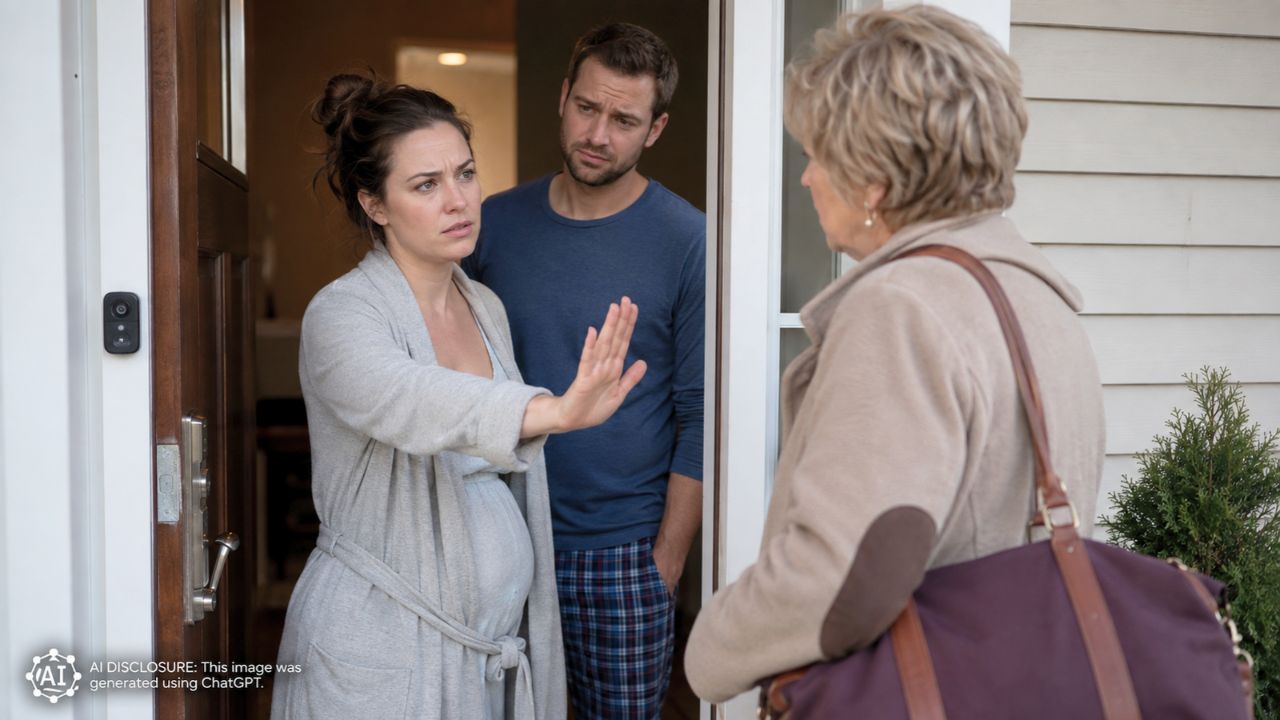
New Mother Banned All Overnight Guests, Including Her Mother-in-Law, for the First Few Days After Giving Birth
Photo credit: AI-generated image created using ChatGPT. Illustrative only.
The plan sounded simple: once the baby arrives, family can come by, meet the newborn, stay for long visits, and soak it all in. The only line this expectant mom wanted to draw was at bedtime—no overnight guests for the first few nights while she and her husband figured out feeding, sleep, and recovery in private.
But when her mother-in-law heard that boundary, the visit turned into an ultimatum. In the original post, the 28-year-old mom-to-be says her husband’s mother, who lives a few states away, told them she wouldn’t come at all if she couldn’t stay under their roof immediately after the birth.
A first baby, a tight window, and a house that suddenly feels small
The woman says she and her husband are expecting their first baby soon—possibly their only child—and they’ve been trying to make a practical plan for long-distance relatives. Her parents live nearby, while her sister and her mother-in-law would need flights. To keep it fair, they planned to call both the sister and the mother-in-law when labor starts, letting them decide whether to book travel right away or wait until after the birth.
There wasn’t a “no visitors” rule. The expectation was that family could visit during the day and into the evening, which matters when out-of-state relatives are trying to squeeze meaningful time into a short trip. The one thing she wanted for herself was quiet nights at home—time to bond, recover, and adjust without someone else in the house.
It’s not hard to see why the nights felt different. She described having social anxiety and a “low social battery,” and she anticipates being exhausted and emotionally raw right after delivery. Even if relatives have the best intentions, she worries that managing a guest—making conversation, hosting, feeling watched—could turn those first nights into something she endures rather than remembers.
She tried to make it fair, and even offered a place to stay
When she brought the no-overnight-guests idea to her husband, he was surprised, but he supported her and agreed they should tell everyone ahead of time. She started with her own mother, framing it as a compromise: come over, help, spend long hours with the baby, but let the new parents have their nights.
Her mother didn’t just accept it. She offered a workaround that would specifically help the mother-in-law: a comfortable guest room at her house. On top of that, the expectant parents also offered to pay for a “nice water side hotel,” giving the mother-in-law two options that weren’t their home.
It was also a tacit attempt to reduce tension. The woman noted that both mothers can be critical—her mom tends to tell her what she’s doing wrong, and her husband’s mom does the same to him. For a couple about to become new parents, those “helpful suggestions” can land like constant judgment, especially when nobody is sleeping.
The response that changed everything: “Then I won’t come”
When the husband relayed the plan to his mom, she became upset, the woman wrote. The mother-in-law’s stance was blunt: if she couldn’t stay in their house, she wouldn’t visit at all.
That reaction hit harder because the couple has always hosted her in the past. The woman says overnight guests already make her anxious, but she’s pushed through because it’s family and she felt like she “should get over” her anxiety. She sees the immediate postpartum period as the one time where “pushing through” could have real consequences—stress, resentment, and a cloud over what she hoped would be intimate, once-in-a-lifetime days.
The husband stayed supportive and emphasized it was his wife’s decision. Still, she could feel the pressure in the background: he wants his mother to meet the baby, and she wants that too. The ultimatum put her in a bind where any outcome feels like a loss—either she gives in and risks feeling overwhelmed, or she holds the boundary and becomes the reason, in the mother-in-law’s eyes, that she “couldn’t” meet her grandchild immediately.
Why the first few nights feel like a high-stakes negotiation
What’s being argued over here isn’t a weekend visit in the abstract. It’s a narrow stretch of time when the mother will likely be bleeding, learning to feed the baby, dealing with unpredictable sleep, and physically recovering. It’s also the period when many new parents are trying to establish routines before outside opinions take over the house.
The woman’s description makes clear she isn’t trying to exclude her husband’s family or elevate her own. Her mom lives close by, but she told her the same rule: no overnight stays for the first few days. That detail matters, because it undercuts the common family accusation that one side is being “favored.”
There’s also a practical piece the mother-in-law’s ultimatum ignores. The couple already offered two realistic alternatives: a free guest room nearby, or a paid hotel. In other words, this isn’t about whether the mother-in-law can physically be there—it’s about whether she can be there on her terms, inside their home, during the most vulnerable part of recovery.
And that’s where the stakes become emotional. The expectant mom said the response has made her feel “anxious and panicked about labor” when she’d been focused on preparing. It’s a lot to carry: anticipating childbirth while also worrying about a relationship rupture that could linger for years.
Reactions centered on boundaries, not gratitude tests
The post itself is labeled “Not the A-hole,” signaling where many readers landed: the new mother isn’t wrong for wanting privacy at night right after giving birth. The general thrust was that postpartum recovery isn’t a normal hosting scenario, and that “help” stops being help when it comes with pressure, criticism, or an expectation of access.
People also zeroed in on the ultimatum as its own kind of message. If the mother-in-law would rather skip meeting her grandchild than sleep somewhere else for a couple of nights, commenters read that as a choice—one that shouldn’t be solved by the person giving birth sacrificing her comfort to manage someone else’s feelings.
Others focused on the husband’s role, not as a referee but as the messenger who has to keep holding the line. He may be supportive in private, but the expectation from readers was that he should present the boundary as a joint decision and avoid framing it as his wife “not allowing” something. In family dynamics, wording becomes fuel, and a new mom doesn’t need to be cast as the villain in the first week home.
What happens next depends on whether anyone blinks
For now, the woman is stuck between two futures. In one, she gives in, hosts overnight, and risks spending those early nights tense, exhausted, and resentful—emotions that don’t vanish just because everyone loves the baby. In the other, she sticks to her plan, and the mother-in-law follows through on not coming, creating a slow-burn fracture that could hang over future visits and holidays.
She’s already tried the obvious compromises: open-door daytime visits, an offered guest room nearby, and a hotel paid for by the couple. What’s left is whether the mother-in-law can accept that a boundary around overnight stays is not a rejection, and whether the husband can keep supporting the plan without letting guilt rewrite it.
At the center of it is a simple request: a few quiet nights for two new parents and their newborn. The mother-in-law may see it as being shut out. The expectant mom sees it as protecting the only version of those first days she’ll ever get.
Check out more from Now Rundown:
- A Party of 12 Came Back a Month Later Demanding Their $80 Tip Refunded — My Restaurant Made Me Pay It
- Her Coworker Kept Filing the Same Complaint About Her After Being Warned — Then She Filed a Counter-Report With Every Email Documented
- Siblings Demanded Half of Their Sister’s $11 Million Inheritance — She Refused Because They Never Visited
- The Kid I Bullied in Middle School Just Interviewed for a Job on My Team — He Bombed It and I Didn’t Hire Him

Abbie Clark is the founder and editor of Now Rundown, covering the stories that hit households first—health, politics, insurance, home costs, scams, and the fine print people often learn too late.