Man Gave His Troubled Brother Access to Their Parents’ House Even Though the Parents Had Banned Him From Coming Back
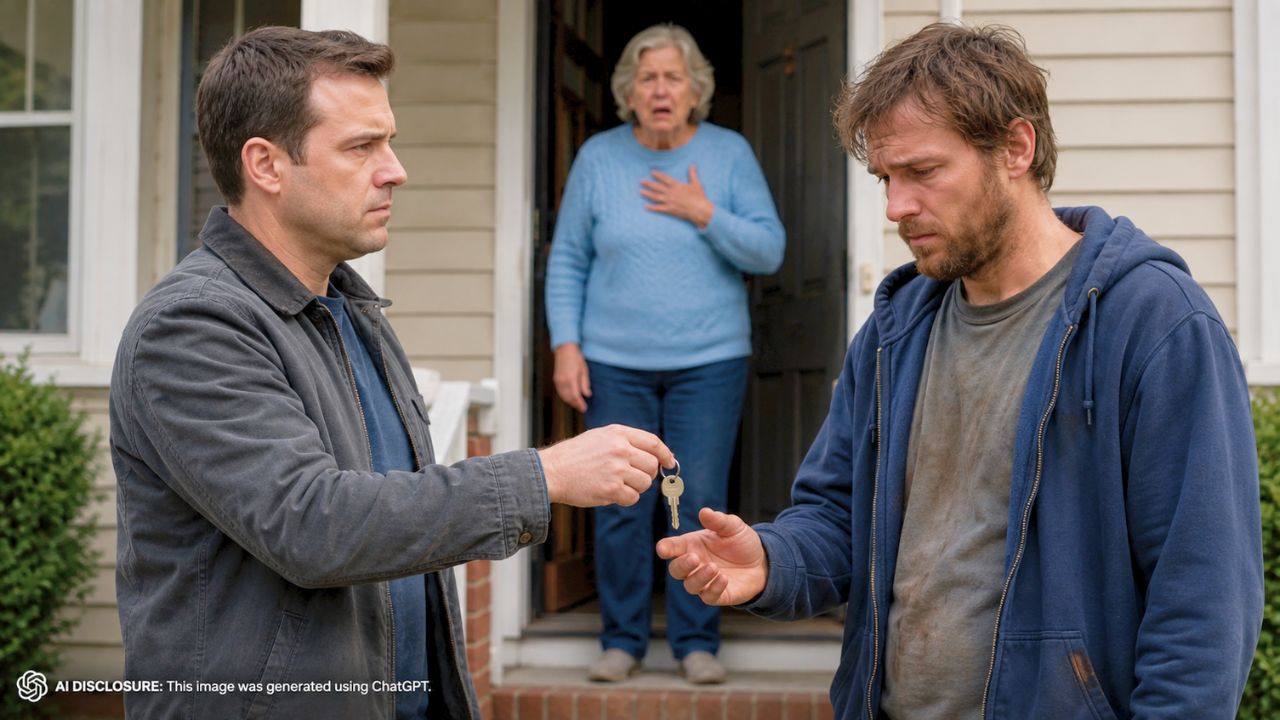
Photo credit: AI-generated image created using ChatGPT. Illustrative only.
When Daniel showed up at his sibling’s front door and tried to let himself in, it wasn’t a misunderstanding. It was a family power play that had been brewing for years—and it ended with Daniel settling into a guest room where he’d been explicitly banned from staying.
In the original post, the writer describes how they refused to house their 34-year-old brother, who has a long history of taking advantage of relatives. After their parents secretly handed Daniel a key to the writer’s home anyway, the writer responded by giving Daniel access to the parents’ house—turning the parents’ “help him out” logic right back on them.
The trust issues weren’t theoretical
The writer says Daniel has spent years living a drifting lifestyle: working just long enough to fund travel, then disappearing for months. On its own, that wouldn’t be anyone else’s problem. The problem, they say, is that Daniel sometimes doesn’t bother earning the money.
They describe him borrowing money from grandparents for car repairs, then moving to Peru for six months. They also say he took books from an uncle and sold them for “several thousand dollars,” justifying it by claiming he’d already read them and the books were “just gathering dust.”
According to the writer, their parents didn’t seriously confront the pattern until Daniel took things from them. Even then, the boundary they set was narrow: he was banned from visiting the house when they weren’t home to supervise him. It wasn’t a full cutoff. It was more like a rule designed to reduce temptation—and keep the peace.
A key became a weapon in a family argument
The standoff escalated as Daniel prepared for another trip. He’d been in town for most of a year and, with his flight leaving mid-month, he gave up his roommate arrangement before he had a place to stay. Rather than paying for an inexpensive short-term rental, the writer says Daniel relied on couch surfing.
Daniel asked to stay with the writer, and the writer said no. Then their parents called to pressure them into changing their mind. The writer refused again, expecting that to be the end of it.
Instead, Daniel appeared at the writer’s home and attempted to use a key. When the writer spoke to him through the door, Daniel admitted he’d asked their parents for help—and they decided the writer was being unfair. So they handed him what they believed was an emergency key.
The writer verified the story with their parents. They say the parents acknowledged giving Daniel the key, reasoning that because the writer travels for work and is “barely ever home,” it shouldn’t matter. But to the writer, it mattered a lot—because the issue wasn’t just valuables. It was access.
Why the writer had already changed their locks
This wasn’t the first time the “emergency key” arrangement had caused problems. The writer says their parents previously used the key to enter and check on them without calling first.
After that, the writer changed the locks and didn’t tell their parents. It was a quiet boundary, but a clear one: no more surprise entries, even from family.
Meanwhile, the writer still had a key to their parents’ home for practical reasons. They used it when the parents traveled—grabbing mail, watering plants, and generally keeping an eye on the place. The parents even had lights on timers, so the writer says the job was minimal. But the access was there.
That access would become the writer’s leverage the moment they realized their parents were willing to override their “no” by handing Daniel a key.
The escalation: “If you want to help him, you can host him”
With Daniel locked out of the writer’s home due to the changed locks, the writer made a choice they admit could look cruel: they opened the door just enough to hand Daniel a key to their parents’ house. The message was blunt—he couldn’t stay with them, but if their parents were determined to help, then Daniel could stay with the people who were pushing the hardest.
The timing made it even more dramatic. The parents were out at dinner when Daniel went to their house. By the time they returned, he had already moved into the guest room and made himself comfortable.
The writer says they don’t believe Daniel has stolen anything during his stay so far. But the parents were furious—not only at Daniel being there, but at the writer for facilitating it. The writer responded by telling family members that their parents attempted the same thing first, just in reverse: they tried to place Daniel in someone else’s home without consent.
The parents’ defense, as the writer describes it, was that Daniel getting into the writer’s house wasn’t a big deal because the writer “live[s] out of a backpack” and doesn’t keep much worth stealing. The writer didn’t buy that logic. Their fear wasn’t jewelry or electronics—it was the kind of chaos that can come from someone treating a home like an opportunity.
They even imagined a worst-case scenario: Daniel “renting” out the place while they were gone and the writer returning to strangers claiming to have a lease. It’s not presented as something that already happened, but as a realistic concern based on Daniel’s track record and comfort crossing lines.
The practical fallout: the parents can’t leave their own house
What followed wasn’t just an argument. It was an immediate lifestyle change for two retired people. With Daniel in their home, the parents now feel they can’t leave the house together. The writer says one of them has to stay behind to supervise him—exactly the kind of monitoring rule they set in the first place.
Daniel’s flight isn’t until the 17th, and at the time of the post he’d only been there a couple of days. Even that short span was enough to “cramp their style,” turning retirement freedom into a rotation of who stays home to keep an eye on a grown adult.
The writer frames this as a direct consequence of the parents’ own choices. If they believe Daniel needs help, they can help him. But they don’t get to volunteer someone else’s home, especially after being told no.
What people tended to focus on: boundaries, keys, and proof
Even without a detailed comment transcript included, the pressure points in the story are obvious: keys, access, and consent. The writer’s decision to change locks after an unannounced entry highlights how quickly “family help” can slide into a loss of privacy.
In similar family disputes, readers typically zero in on practical steps: lock changes, retrieving spare keys, and making sure no one can duplicate or distribute access without permission. The writer already took the first step by changing their locks, and the parents learned—suddenly and uncomfortably—what it feels like when access is treated casually.
The unresolved problem is that Daniel’s travel date is still weeks away, and supervision is now the parents’ daily burden. The writer may have proven a point, but the family is left in a tense waiting period: Daniel has a place to sleep, the parents are angry and on guard, and the writer is standing by the boundary they tried to set from the beginning.
Check out more from Now Rundown:
- A Party of 12 Came Back a Month Later Demanding Their $80 Tip Refunded — My Restaurant Made Me Pay It
- Her Coworker Kept Filing the Same Complaint About Her After Being Warned — Then She Filed a Counter-Report With Every Email Documented
- Siblings Demanded Half of Their Sister’s $11 Million Inheritance — She Refused Because They Never Visited
- The Kid I Bullied in Middle School Just Interviewed for a Job on My Team — He Bombed It and I Didn’t Hire Him

Abbie Clark is the founder and editor of Now Rundown, covering the stories that hit households first—health, politics, insurance, home costs, scams, and the fine print people often learn too late.