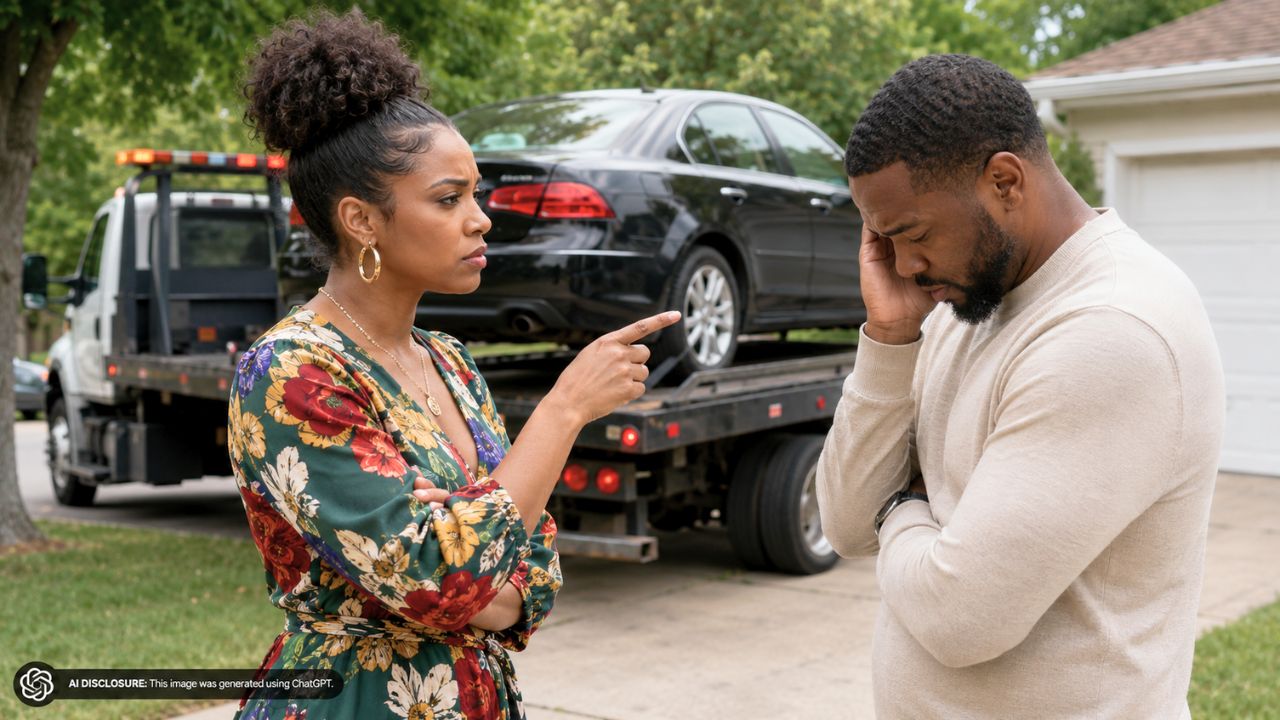
Wife Gave Her Husband an Ultimatum After His Car Was Repossessed Over Debt He Hid From Her for the Second Time
Photo credit: AI-generated image created using ChatGPT. Illustrative only
It started like a worst-case morning: she and her husband woke up and his car was simply gone. For a moment, she thought it had been stolen. Then the real answer landed even harder—his vehicle had been repossessed after four months of missed payments.
In the original post, the wife laid out how quickly the shock turned into anger once she realized this wasn’t just bad luck. She says it was the second time he’d hidden serious money trouble from her, and this time the consequences were already parked on their doorstep.
A car vanishes, and the explanation changes everything
When she learned the car wasn’t stolen, the next details made her feel like she couldn’t catch her breath. Her husband was crying and apologizing, telling her he was “gonna fix it this week when he got paid.” To her, that translated to something else: he never planned to tell her at all.
She immediately started running through the practical fallout. To get the car back, she said they’d have to cover the past-due payments plus additional fees. And if the lender sells the vehicle for less than what’s owed, she worried they could be sued for the remaining balance.
Then there’s the longer shadow: a repossession can damage credit for years. In her mind, this wasn’t about a missing car for a few days—it was about the kind of financial mark that can affect everything from future loans to housing options.
The first warning sign had already happened
The repossession didn’t come out of nowhere. She said there had been an earlier episode that made her set a hard boundary around honesty and money.
After her husband lost his job last year, she found a notice on the door warning their water would be shut off because the bill was four months behind. That moment prompted a serious conversation: she told him marriages often collapse over finances, and she needed him to stop hiding problems so they could solve them together.
He promised he wouldn’t keep financial trouble from her again. She believed him—especially because the explanation at the time sounded plausible. She later added that the water and electric were handled by the same company, didn’t offer autopay, and he claimed he thought paying the electric covered both.
Six months into marriage, the trust test arrived early
One detail added urgency: they haven’t even been married a full year. Their wedding was six months ago, and she described feeling blindsided so early into what was supposed to be a fresh start.
Before the wedding, they had tried to structure things in a way that would reduce missed payments and confusion. After his layoff, he found two jobs, but wasn’t earning what he was used to. They agreed she would take over many household bills—phones, internet, electric, water, sewer, garbage, a storage unit, and surprise house costs—while he would handle the mortgage, his car and insurance, and his credit cards. She’d cover her own car, insurance, and credit cards.
They even sat down a month before the wedding to write out a budget and planner, and she says he paid his debt down to zero. She described it as a requirement before she’d walk down the aisle: she wanted them starting married life with a clean slate.
That’s why the repossession hit like a second betrayal. In her view, it wasn’t only that he fell behind—it was that he recreated the same secret-keeping pattern after promising it wouldn’t happen again.
Proof replaced promises when she started checking the bills
After learning about the repossession, she didn’t stop at the car. She grilled him on every other bill, especially the mortgage, because the house was the next thing she feared losing.
He told her he’d never missed a mortgage payment, but she didn’t accept a verbal answer. She made him show proof, explaining that she couldn’t take anything at face value anymore. At least on that front, she said the documentation backed him up—the mortgage truly hadn’t been missed.
Still, the act of needing to audit her own marriage was its own kind of damage. She went from trusting him to needing receipts, not because she wanted control, but because she no longer felt safe assuming he was telling the whole story.
She also clarified a major logistical wrinkle: the big assets aren’t jointly held. His car was his before they met and is leased in his name only. Her car is hers and is financed in her name. The house is also in his name—he bought it before they met. At this point, she said, nothing significant has both of their names on it.
Her ultimatum wasn’t about the car—it was about the secrecy
In the middle of the chaos, her husband tried to minimize the immediate loss. He argued that it’s “just a car,” that he can use hers, and that marriage means sticking it out “no matter what.”
She drew a line. When he insisted it wouldn’t happen again, she told him it wouldn’t—because if it did, she’d leave. She framed it as a trust issue, not a transportation issue. If he hides debt again, she doesn’t want to stay married to someone she feels she has to constantly fact-check.
He called the ultimatum unfair, suggesting that the commitment of marriage should override even repeated financial dishonesty. But for her, the marriage commitment was exactly why the secrecy felt so serious: she’d already warned him once, and the second time came with consequences they couldn’t undo.
What others honed in on: broken trust and the paper trail
In her update, she noted that many people focused on the same point she raised in her argument with him: the core problem is that trust has been broken. “I didn’t do that,” she told him. “You did.”
The fact that she had already demanded transparency after the water shutoff notice—and still ended up surprised by a repossession—made the story feel less like a one-off mistake and more like a pattern. And once a relationship gets to the point where one spouse has to demand proof of mortgage payments on the spot, it’s hard to pretend the issue is confined to one missed bill.
For her, the ultimatum is an attempt to stop the spiral early: no more secret debt, no more last-minute emergencies, no more learning the truth only after a tow truck has already come and gone. The car can be replaced or recovered. The bigger question is whether the honesty can be.
Check out more from Now Rundown:
- A Party of 12 Came Back a Month Later Demanding Their $80 Tip Refunded — My Restaurant Made Me Pay It
- Her Coworker Kept Filing the Same Complaint About Her After Being Warned — Then She Filed a Counter-Report With Every Email Documented
- Siblings Demanded Half of Their Sister’s $11 Million Inheritance — She Refused Because They Never Visited
- The Kid I Bullied in Middle School Just Interviewed for a Job on My Team — He Bombed It and I Didn’t Hire Him

Abbie Clark is the founder and editor of Now Rundown, covering the stories that hit households first—health, politics, insurance, home costs, scams, and the fine print people often learn too late.