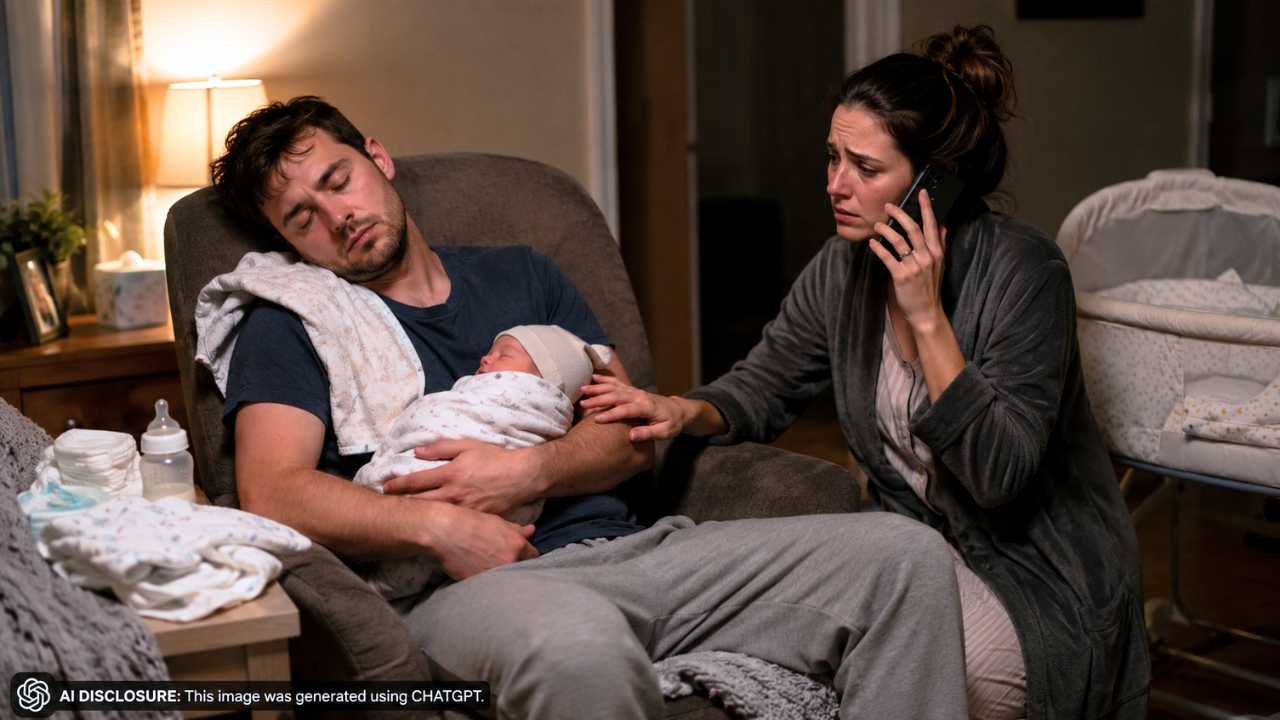
My Husband Fell Asleep Holding Our 3-Day-Old — So I Called His Mother and Now He Says I Betrayed Him
Photo credit: AI-generated image created using ChatGPT. Illustrative only.
By the time their baby was just weeks old, this new mom felt like she was living in two realities at once: a husband who genuinely adored their child, and a husband who kept doing things that made her stomach drop. She didn’t doubt his love. She doubted his judgment, especially when exhaustion and “it’ll be fine” started mixing in the living room.
After one too many moments that felt unsafe, she stopped trying to argue him into change on her own. She called in reinforcements—his mother and sister—and asked them to talk to him. They didn’t just talk. They took her side and “ripped him a new one.”
Now he’s furious, saying she turned him into the villain and betrayed him by involving his family. She’s left wondering whether she crossed a line—or whether that line moved the moment the baby’s safety felt like it was up for debate.
The fear wasn’t about love. It was about basic safety.
In her telling, her husband is an involved dad who wants “every available moment” with their infant. That’s the part she appreciates and doesn’t want to lose. But she says his enthusiasm comes with habits she can’t shake off as dangerous.
She describes him falling asleep on the couch while their baby is contact-napping on him. She also says he’s left the baby on a playmat unattended while the dog is in the room, and put the baby down for a daytime nap with a bib still on.
To her, these aren’t picky parenting preferences. They’re the kinds of things that can go wrong fast, even with a baby who can’t roll yet. And she says the stress has piled up to the point where she doesn’t feel comfortable leaving him alone with the child—something that understandably stings for a parent who thinks they’re doing their best.
Every time she panicked, he dug in harder
The biggest problem, she explains, is that they aren’t just disagreeing; they’re escalating each other. She says she doesn’t respond calmly. She “freaks out,” which she admits makes him defensive.
From his side, he argues she’s being overly anxious and “making a big deal out of nothing.” In his view, the baby can’t roll, the dog won’t hurt the baby, and he holds the baby firmly even if he dozes off.
That difference in risk tolerance has turned their home into a constant standoff. Her vigilance reads like criticism to him. His confidence reads like carelessness to her. And with sleep deprivation in the mix, neither of them seems to be hearing the other clearly.
The moment she stopped negotiating and started escalating
Eventually, she says she hit a wall. “Last week I had enough,” she wrote, describing a decision to bring his family into the conversation. She reached out to her mother-in-law and sister-in-law and asked them to talk to him.
What she wanted sounds straightforward: back her up, get him to take safety issues seriously, and make changes that she’d been unable to get through to him herself. In other words, she went looking for leverage—not to punish him, but to break a pattern that was leaving her constantly on edge.
The conversation didn’t land gently. According to her account, both women took her side and confronted him hard. Instead of a calm “here’s what to do differently,” it became a dressing-down. That might have gotten the message across, but it also changed the emotional stakes inside the marriage.
He says it wasn’t about parenting anymore—it was about loyalty
Her husband’s reaction wasn’t focused on the couch naps or the bib. He was angry about the method. He accused her of making “a whole intervention,” as if she’d staged a family ambush to label him a bad father.
To him, involving his mother and sister wasn’t a safety move; it was a betrayal. It made the disagreement public inside the family and put him on the defensive in a way he couldn’t easily reset. Even if he changes his behavior, he now has to carry the feeling that his own family sees him as reckless.
To her, the outrage misses the point. She isn’t describing a man who doesn’t care—she’s describing a man who dismisses her concerns until someone else says the same thing louder. And now she’s stuck with a brutal tradeoff: she got backup, but she may have damaged trust in the process.
Her full account appears in the original post, where she asks whether insisting on change—and pulling in his relatives—made her the one in the wrong.
What people zeroed in on: preventable risks and preventable resentment
The post itself is labeled “Not the A-hole,” and the details make it clear why many readers would land there: the behaviors she lists are the kinds of lapses that can be avoided without demanding anyone be a perfect parent. Staying awake during contact naps, keeping a close eye when a pet is around, and removing a bib before sleep are all changes that don’t require expensive gear or complicated routines.
At the same time, her description also highlights a second issue commenters often home in on in new-parent fights: how quickly “you’re doing it wrong” can turn into “you think I’m a bad parent.” She acknowledges that she “freaks out,” and in a home already flooded with exhaustion, that delivery can turn safety reminders into personal attacks.
Even without a long comments section included here, the tension is familiar: one parent wants strict guardrails; the other wants flexibility and trust. The risk is that the argument stops being about the baby’s environment and starts being about who gets to be the competent adult.
They still have the same baby, the same exhaustion, and a new family wound
There’s no neat resolution in her update because the underlying problem isn’t a single mistake—it’s a pattern, and a disagreement over whether it’s even a problem. If her husband doubles down, she may feel even more like she can’t step away. If she keeps calling in outside enforcement, he may feel increasingly cornered and humiliated.
The most immediate consequence is practical: how do they share childcare if one parent doesn’t trust the other’s choices? That kind of mismatch doesn’t just create arguments; it creates a daily logistics problem, especially when both parents need rest and breaks to function.
For now, she’s left balancing two urgent realities at once: she wants her husband to be deeply involved, and she wants the baby handled in ways that don’t require her to hold her breath. The family “intervention” may have forced the issue into the open. It also ensured that whatever happens next won’t be just between the two of them.

Abbie Clark is the founder and editor of Now Rundown, covering the stories that hit households first—health, politics, insurance, home costs, scams, and the fine print people often learn too late.